
Frankincense vs Myrrh: What's the Difference?
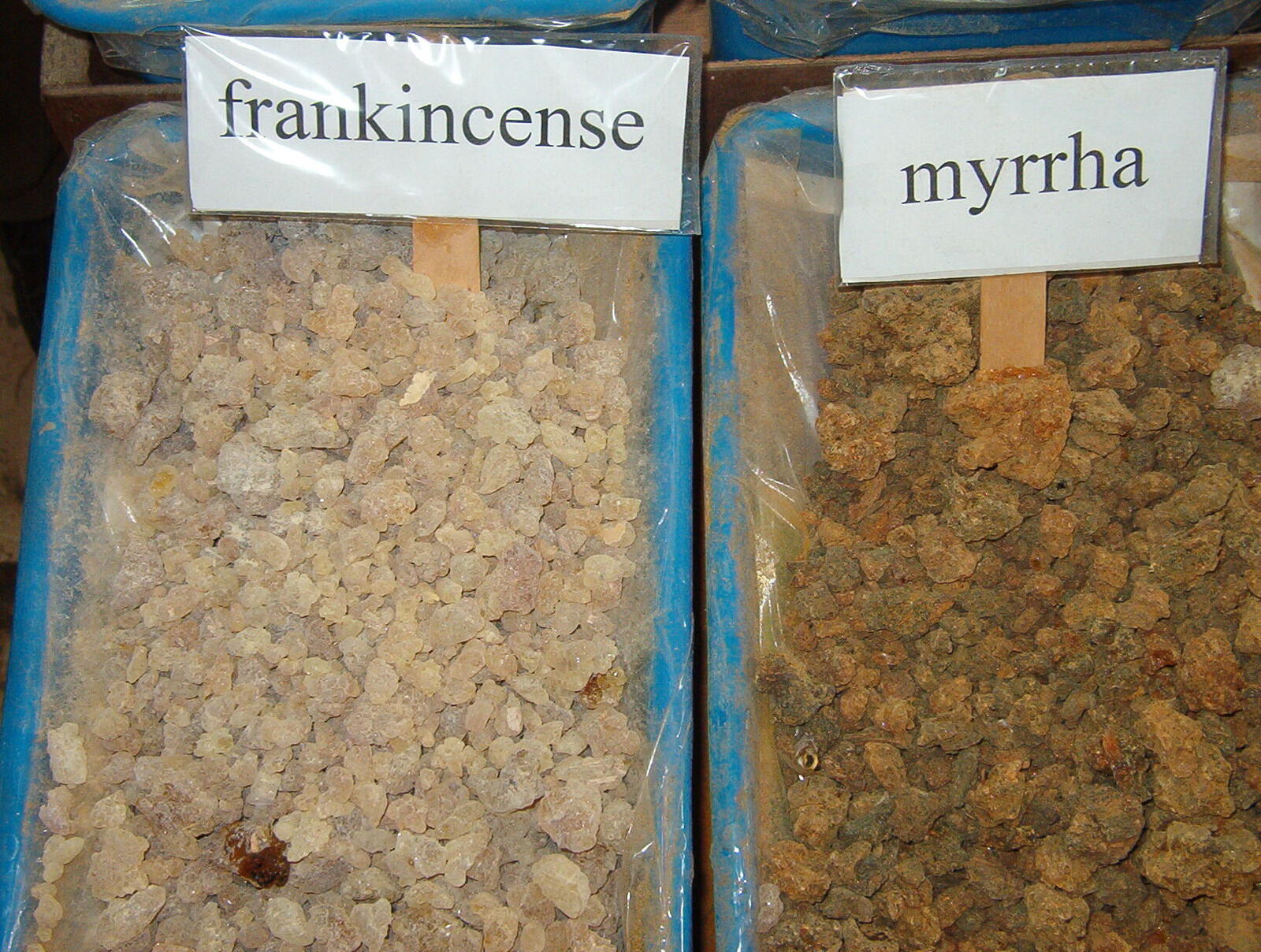
Frankincense and myrrh are both aromatic tree resins from the same botanical family, but they come from different genera, grow in different regions, and produce completely different scents. Frankincense is pale, bright and citrusy. Myrrh is dark, earthy and bitter. They were traded together, but used very differently.
If you are new to burning resins, the short answer is this: frankincense comes from Boswellia trees and smells like lime, pine and eucalyptus. Myrrh comes from Commiphora trees and smells like bitter earth, aged wood and warm resin. They belong to the same plant family (Burseraceae) but they are as different as orange and oak.
The confusion is understandable. Both are gum resins harvested by scoring tree bark. Both come from the same general part of the world: the arid scrublands of the Horn of Africa and the southern Arabian Peninsula. Both were carried along the same Incense Roads for millennia, traded at gold-equivalent prices, and given as gifts alongside precious metals. And both ended up in the same biblical story. So it is natural to assume they are interchangeable. They are not.
What Kind of Tree Does Frankincense Come From?
Frankincense is the hardened sap of trees in the Boswellia genus. The species that produces the highest-grade aromatic resin is Boswellia sacra, a small tree native to the limestone mountains of Oman's Dhofar region and parts of Yemen and Somalia. It grows to about eight metres tall, with papery bark and sparse, twisted branches. It thrives on bare rock with almost no soil, and it depends on the seasonal monsoon for moisture.
Other Boswellia species produce commercial frankincense too. Boswellia papyrifera in Ethiopia, Eritrea and Sudan supplies the resin used in the Ethiopian Orthodox Church, as we explored in our piece on that tradition. Boswellia serrata in India produces a resin called salai guggul, used more in herbal medicine than incense. But the gold standard for fragrance is B. sacra.
The resin exudes when the bark is cut. It starts as a milky white sap that hardens into pale amber or greenish tears. The top grade is Royal Green Hojari: translucent, emerald-tinted tears with the highest volatile oil content. Lower grades are darker and dustier, with less aromatic complexity.
What Kind of Tree Does Myrrh Come From?
Myrrh comes from trees in the Commiphora genus, primarily Commiphora myrrha. These are smaller than Boswellia: gnarled, thorny shrubs that rarely exceed three metres tall. They grow on parched rocky hillsides in Yemen, Somalia, Ethiopia, and across the Arabian Peninsula. The tree has grey-green leaves, long spines, and the same papery bark as its Boswellia cousin. The resin ducts run through the bark, and when the bark splits naturally or is cut by a harvester, myrrh weeps out as a pale yellow fluid that darkens to reddish-brown as it hardens.
Unlike frankincense, which hardens into brittle tears within a couple of weeks, myrrh remains slightly soft and tacky even after curing. It collects in irregular lumps and globules rather than neat droplets. The word myrrh comes from the Arabic murr, meaning bitter, which describes both its taste and its scent profile. The Britannica entry for myrrh notes its long history of use as a flavouring agent, aromatic ingredient and traditional medicine.
Are They from the Same Plant Family?
Yes. Both Boswellia and Commiphora belong to the Burseraceae family, also called the incense-tree family. That family connection is why the two resins share some structural similarities: both are oleo-gum-resins, meaning they are complex mixtures of essential oils, gums and resinous compounds. But the chemistry diverges once you look closer. Frankincense is dominated by monoterpenes like alpha-pinene (pine), limonene (citrus) and alpha-thujene, which produce the sharp, volatile top notes. Myrrh is richer in sesquiterpenes, which are heavier, less volatile molecules that produce its earthy, balsamic base.
As a 2024 review from the NIH notes, frankincense is rich in boswellic acids and triterpenoids, while myrrh contains sesquiterpenes and flavonoids that contribute to its distinct profile. The two resins complement each other, but they are chemically distinct.
How Do They Smell Different?
This is where the difference hits you fast. Good frankincense hits you immediately. Put a tear on a low electric burner and within seconds the room fills with lime zest, pine needles and a cooling menthol-like note. It is bright, clean and penetrating. Royal Green Hojari is especially piercing: one small tear can scent an entire room for half an hour, releasing its profile in layers as the heat works through the resin.
Myrrh does not hit you. It rises slowly. The scent is dark, sweet-bitter, balsamic, with notes of resinous wood, dried herbs and a faint medicinal edge. Where frankincense opens the space, myrrh closes it. It is heavier and more grounding. The chemical reason is the sesquiterpene content: these larger molecules evaporate at higher temperatures and linger longer on surfaces.
If you have only ever smelled one, the best comparison is this: frankincense is the top note of a freshly cut lime. Myrrh is the bottom note of an old wooden church.
How Do You Burn Each One?
They burn differently enough that we wrote a full guide on how to burn both resins. But the short version: frankincense wants gentle heat and a short session. A pea-sized piece on an electric warmer at 180 degrees will release its character in 20 to 30 minutes. Beyond that, the top notes fade and the remaining resin turns flat.
Myrrh benefits from slightly more heat and a longer burn. It needs a higher temperature to release its heavier oils, and it keeps releasing them for longer. On a charcoal disc, myrrh will smoulder for hours, gradually shifting from sharp-bitter to sweet-balsamic. It also makes a good base note when blended with frankincense: put the myrrh on first, let it warm up, then add a small piece of frankincense on top.
Which One Should I Try First?
If you are new to resin incense, start with frankincense. Its bright, familiar profile is easier to appreciate on first contact. A small sample of Royal Green Hojari will show you what the fuss is about within seconds. Once you understand what a clean, high-quality resin smells like, move to myrrh. The contrast will make more sense when your nose has a reference point.
If you already enjoy both, try burning them together. They complement each other the same way they complemented each other on the Incense Roads: frankincense for the bright opening, myrrh for the long finish. Our Reserve has both, sourced from the same regions the caravans passed through two thousand years ago.