The Incense Roads: How Frankincense Built the Ancient World's Most Valuable Trade Route
For two thousand years, the most valuable thing you could move across a desert wasn't gold or silk. It was tree sap.
The resin of the Boswellia sacra tree, harvested from a single mountain range in southern Oman, traded at gold-equivalent value across the ancient world. The route that carried it ran 1,200 miles from the Dhofar plateau to the Mediterranean ports. It built cities, bankrolled empires, and connected worlds that never met face to face.
The Dhofar Monopoly
The whole thing began in one place. The Dhofar region of Oman — specifically the mountain slopes where the summer monsoon collides with desert heat — grows a strain of Boswellia sacra that has no equivalent anywhere else. The Greeks called it "libanos." The Romans burned it by the ton. But they couldn't grow it. The tree simply wouldn't live outside its microclimate.
That geographic monopoly gave the kingdoms of southern Arabia an extraordinary lever. The Sabaeans and Hadhramis controlled production and deliberately obscured where the trees stood. Pliny the Elder wrote that frankincense could only be harvested by designated families, and that cutting a tree with an iron blade invited divine punishment. The secrecy worked. For centuries, no one outside Arabia knew exactly where the resin came from. The same Royal Green Hojari we source today grows on those same protected slopes.
The Caravan Road
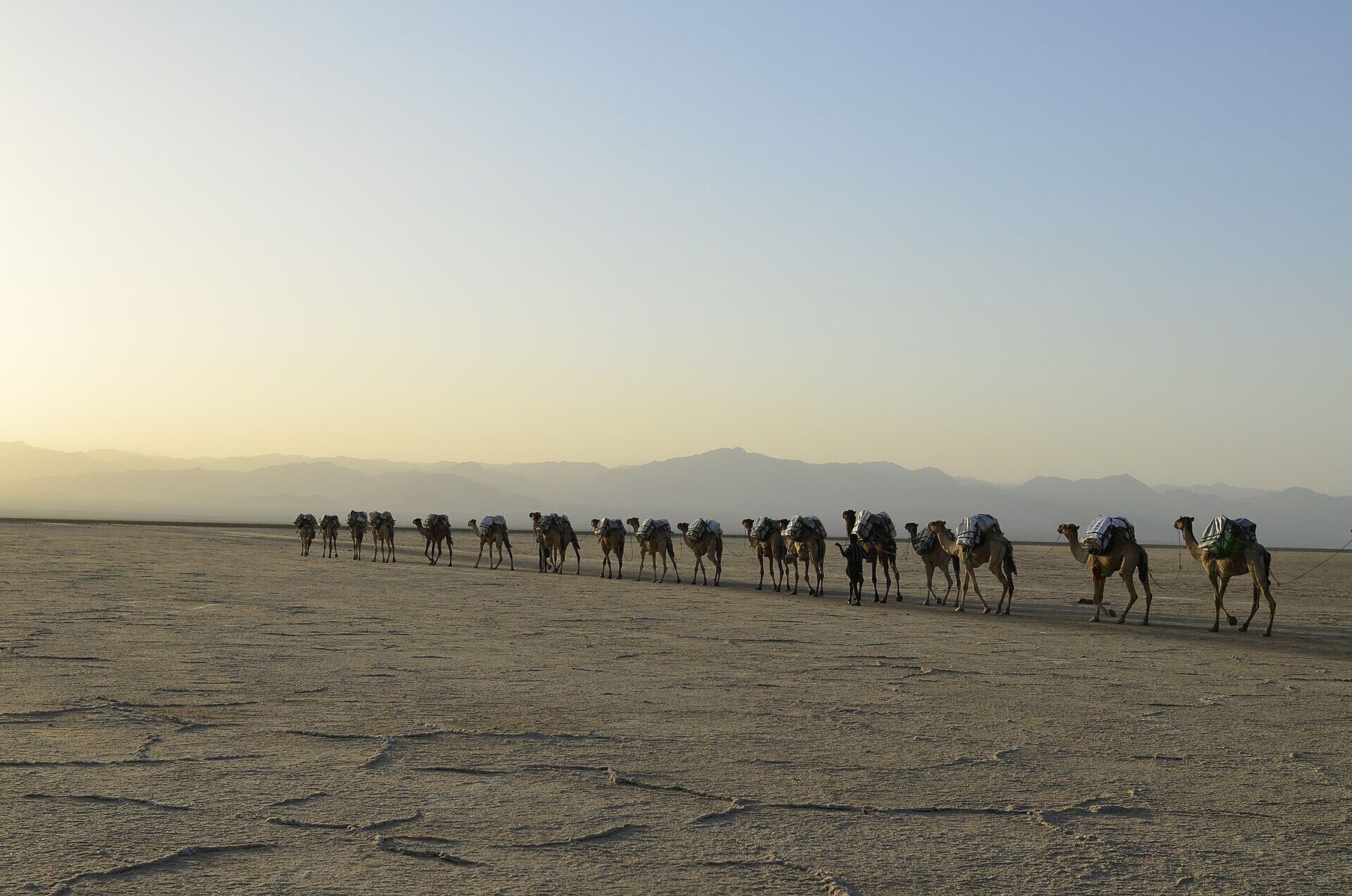
Once collected, the resin headed north. The overland route ran roughly 1,200 miles from the Yemeni highlands through the Arabian desert, hugging the western edge of the peninsula about 100 miles inland from the Red Sea. Camels carried the load — roughly 400 pounds per animal — in caravans that could stretch hundreds of animals long. Pliny recorded 65 stages on the journey, each a day's march between watering holes. The full trip took about two months.
Along the way, caravans passed through the kingdoms of Qataban, Saba, and Ma'in. Each levied tolls. The costs stacked up fast. By the time the resin reached Gaza on the Mediterranean, its price had multiplied many times over — which is how a desert sap came to be worth more than gold.
The southern terminus was Shabwa, in modern Yemen. The northern hub was Petra, the Nabataean city carved into rose-red rock in present-day Jordan. The Nabataeans controlled the northern leg of the route and grew staggeringly wealthy doing so. Petra sat at a strategic chokepoint where the incense road from Arabia crossed the north-south corridor linking the Red Sea to Damascus. They taxed everything that passed.
The Sea Route
Not all the resin traveled over land. The port of Sumhuram (Khor Rori) on the Dhofar coast handled maritime shipments, sending frankincense across the Arabian Sea to Qana on the Yemeni coast and from there to India, the Persian Gulf, and Egypt. Roman ships carried it from the Red Sea ports to Alexandria and the rest of the empire.
The sea route was faster and cheaper, but it had its own costs: pirates, storms, and the monsoon winds that dictated when ships could sail. The Periplus of the Erythraean Sea, a first-century Greek navigational text, gives minute instructions for timing the crossing. Even then, cargo was lost.
What the Roads Left Behind
The Incense Roads didn't just move resin. They moved ideas. The Nabataeans learned irrigation systems from the Sabaeans. Greek art styles traveled east on the same routes that carried resin west. The Queen of Sheba's visit to King Solomon was, in all likelihood, a trade negotiation disguised as a diplomatic mission — securing access to the frankincense trade from her southern territories.
When the Roman Empire fell and the routes shifted, the cities that had grown fat on incense tolls crumbled first. Petra was abandoned. Shabwa was buried by sand. Knowledge of where frankincense came from faded so thoroughly that medieval Europeans believed it grew in the Garden of Eden.
The trees are still there. UNESCO recognized the Land of Frankincense as a World Heritage site in 2000, protecting Wadi Dawkah's groves and the ancient port of Khor Rori. You can still walk the same ground the caravans crossed. Or, if a trip to Oman isn't in the cards this year, you can explore that heritage through the aromatic specimens we source from the same region today. The sap hasn't changed. The line connecting that mountainside to your burner is just a little shorter than it used to be.