
The Smoke That Precedes the Gospel: Frankincense in the Ethiopian Orthodox Church
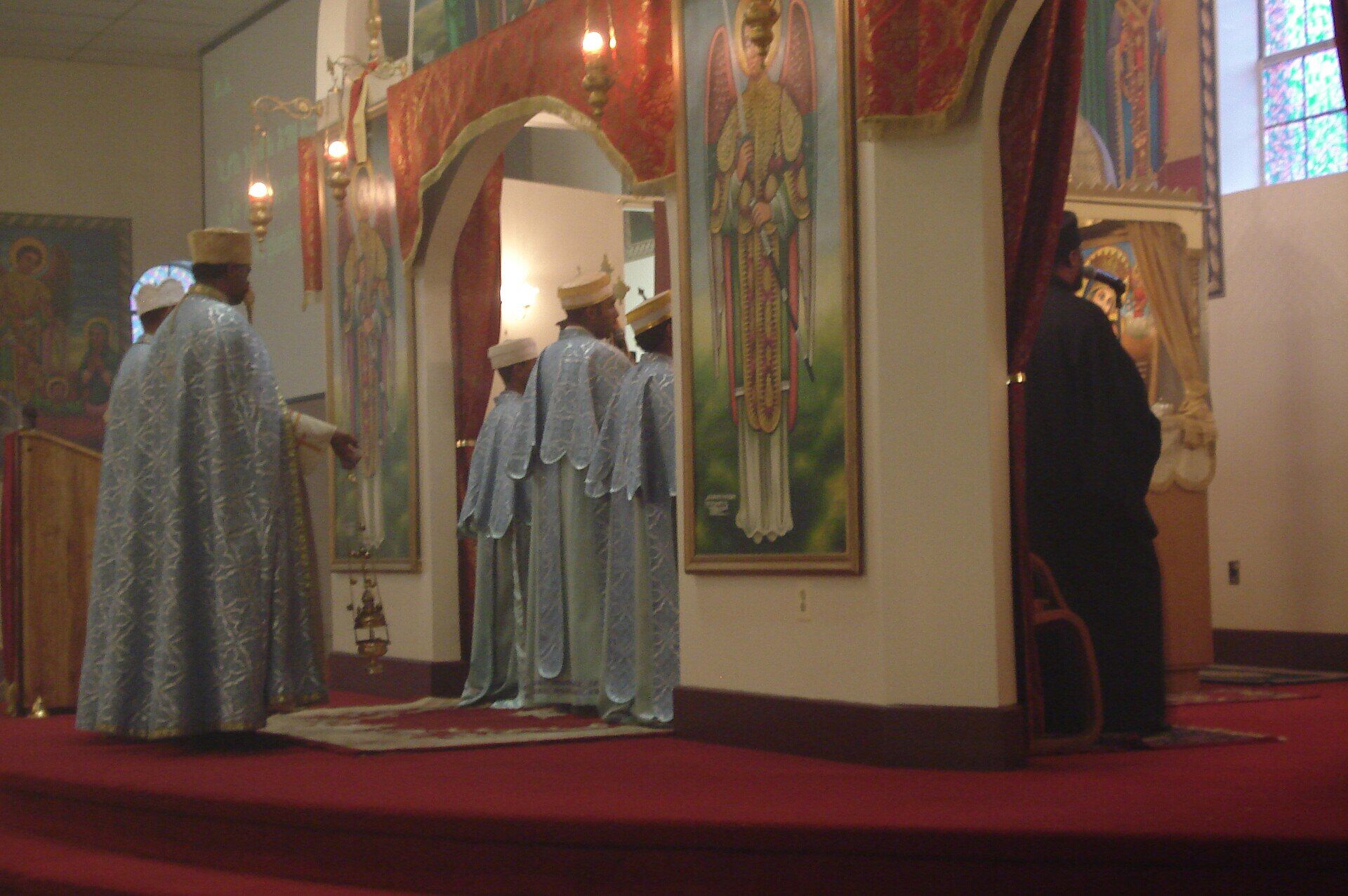
In the Ethiopian Orthodox Church, the Gospel never enters the room alone. The smoke goes first.
The priest blesses five grains of frankincense. He places three of them on the glowing coals of a brass censer shaped like a chalice with a cross-topped handle. The smoke rises, white and heavy. The deacon fans it toward the altar, toward the icons, toward the congregation. Then, and only then, does the sub-deacon carry the Gospel book from the sanctuary to the reading desk, preceded by candles and the thickening cloud. The incense does not accompany the Word. It prepares the space for it.
A Church Built on Smoke
Christianity reached Ethiopia in the fourth century CE, when St. Frumentius, a Syrian Christian shipwrecked on the Red Sea coast, made his way to the Aksumite court and convinced the Emperor Ezana to convert. Frumentius was consecrated bishop by St. Athanasius in Alexandria and returned to Ethiopia with the Alexandrian liturgy, which included incense as a central element of worship. The Ethiopian Orthodox Tewahedo Church has been burning frankincense in its services ever since: continuously, daily, for over 1,600 years.
That continuity is what makes it remarkable. The Ethiopian church, isolated in the highlands of the Horn of Africa, kept its Alexandrian inheritance largely intact and in doing so preserved an unbroken liturgical tradition that connects the modern church directly to the worship of late antiquity. The same smoke that filled the basilicas of Aksum in 350 CE fills the churches of Addis Ababa, Washington DC, and Tel Aviv today.
The liturgical rules are precise. Incense is compulsory at every service except the rites of Penance and the Reconciliation of Apostates. Only a priest or bishop may swing the censer. A deacon can carry the incense container (muday) or tend the coals, but not offer the incense itself. Every morning, each church celebrates the Prayer of Incense (Sälotä éian), a service of psalms and prayers that concludes with the Prayer of the Covenant. During the Divine Liturgy, the priest blesses five selected grains of incense and places three of them on the coals during the solemn incensation that follows the reading of the Gospel. A large church can use up to 150 kilograms of frankincense per year.
The Tree That Supplies the Altars
The frankincense that feeds this tradition is not the same species that built the Incense Roads out of Oman. The resin that fills the censers of the Ethiopian church comes primarily from Boswellia papyrifera, a tree that grows across a belt of dry woodland stretching from northern Nigeria through Cameroon, Chad, Sudan, Eritrea, and into the highlands of Ethiopia. Where Omani Boswellia sacra is prized for its pale, translucent tears and piercing citrus-pine top notes, B. papyrifera produces a darker, stickier resin: more amber than gold, with a warmer, sweeter, balsamic profile that suits the heavy, ceremonial character of Orthodox incensation.
The trees grow in the Terminalia-Combretum woodlands of the lowlands: the hot, dry valleys of the Tekeze and Abay (Blue Nile) catchments in northern and northwestern Ethiopia. A mature tree stands ten to twelve metres tall in the lowlands, shorter in the highlands. Its bark is pale and papery, peeling in thin flakes: the species name papyrifera refers to this papery bark. The resin exudes when the bark is wounded, hardening into tears that range from pale yellow to dark reddish-brown depending on the age and condition of the tree. Ethiopia is one of the world's largest exporters of frankincense, and the majority of its production is B. papyrifera.
The chemistry is distinct from the Omani species. B. papyrifera resin is higher in octyl acetate and lower in alpha-pinene than B. sacra, which accounts for its sweeter, less piercing scent. On a charcoal disc, the tears melt more slowly than Omani hojari, releasing a dense, honeyed smoke with a warm balsamic body and none of the sharp lime top note that defines Royal Green Hojari. It is a completely different aromatic experience: warmer and rounder, made for long services rather than a quick, bright burst.
The Church That Saved the Trees
One of the less expected consequences of the Ethiopian Orthodox Church's deep-rooted presence in the highlands is that its churchyards, the circles of forest that surround every traditional church, have become some of the most important biodiversity refuges in the country. Ethiopia has lost over 90% of its forest cover over the past century. But the forests that remain standing are often those that surround Orthodox churches and monasteries.
Known as church forests, these patches of native woodland are protected by religious doctrine, tradition, and the physical presence of the clergy. The trees are not cut. The land is not cultivated. The shade they cast is understood as part of the sacred space. Botanists who have surveyed them describe these churchyards as some of the last refuges of the dry Afromontane forest that once covered the northern highlands, and in many districts they are the only places where native trees still regenerate naturally.
The paradox is that the same church whose liturgy consumes 150 kilograms of frankincense per year may also be the last best hope for the trees that produce it. The church forests do not grow B. papyrifera. That tree lives in the hot lowlands, not the cool highlands, but they represent a model of conservation that the lowland woodlands urgently need: locally managed, culturally embedded, and sustained by religious practice rather than state regulation. As we covered in our piece on frankincense sustainability, the same pressures that threaten Boswellia sacra in Oman (over-tapping, grazing and agricultural encroachment) are pushing B. papyrifera toward collapse across Ethiopia, Eritrea, and Sudan.
The Quiet Collapse of Boswellia papyrifera
The research on B. papyrifera is cumulative and grim. A 2019 synthesis published in Nature Sustainability, using data from 23 populations and over 21,000 trees, found that more than 75% of studied populations show no regeneration. Seedlings and saplings are absent. The trees that remain are mature and aging, with no younger generation coming up behind them. The authors projected that frankincense production from B. papyrifera will be halved within 20 years, and that the population will decline by 90% within 50 years.
The causes are not in dispute. Over-tapping is the primary driver. A tree that is tapped too frequently produces fewer flowers and seeds, and the seeds it does produce have sharply reduced viability. A study in Eritrea found 80-94% germination rates in seeds from untapped trees, against 14-16% for seeds from trees that had been tapped. The resin harvesters are often paid by volume, which creates an incentive to cut as many trees as possible, as deep as possible, with no regard for long-term survival. In the Metema district of northwestern Ethiopia, 65% of privately managed trees had over 12 tapping spots: more than double the recommended maximum.
Cattle grazing kills seedlings before they can establish. Fire, both natural and set accidentally by farmers clearing land, burns the thin-barked juvenile trees. The lowland woodlands that B. papyrifera depends on are being converted to agriculture and grazing land at a steady rate. The species is currently assessed as Vulnerable on the IUCN Red List, but a 2025 assessment for Ethiopia recommended upgrading it to Endangered based on the pace of decline.
The irony is that B. papyrifera has a broader natural range than B. sacra. It grows across nine African countries, but it has been subjected to more intense pressure because the communities that rely on it are poorer and have fewer alternatives. The tree that supplies the incense for one of the world's oldest Christian liturgies is being tapped to death by people who cannot afford to let it rest.
What the Smoke Knows
The priest lifting the censer. The smoke accumulating at the ceiling. The deacon fanning it toward the icons. The Gospel entering a space that had already been filled, saturated, prepared. In the Ethiopian Orthodox understanding, incense does not just symbolise prayer. It is the physical form of prayer rising toward God. The white smoke is the visible shape of something invisible. The censer is not a tool. It is an instrument of the same liturgy that has been performed in the same language, with the same gestures, on the same continent, for sixteen centuries.
The resin that makes that possible is running out. Not because the world has stopped burning frankincense. The opposite is true: the global market for frankincense continues to grow. The problem is that the specific tree that supplies the Ethiopian church and a significant portion of the international market cannot sustain the harvest pressure it is under. The same pattern we have documented across multiple other aromatic species including Omani Boswellia sacra, Indian Commiphora wightii and Turkish Liquidambar orientalis is playing out in the dry woodlands of Ethiopia, Eritrea, and Sudan, with less international attention and fewer resources for conservation.
For a broader look at how different frankincense species compare, and where B. papyrifera sits in the family, our field guide to frankincense species covers the full range from Omani sacra to Indian serrata to Ethiopian papyrifera. The differences between them are not academic. They determine which resin burns on which altar, in which part of the world, in which tradition. And in Ethiopia, one of the oldest continuous traditions of incense in the world depends on a tree that is running out of time.