The Anatomy of the Frankincense Tree: A Botanical Portrait of Boswellia Sacra
It's easy to forget, when you're looking at a small amber tear on a burner, that it came from a living thing. A tree that grows in one of the most punishing environments on earth, and has spent millions of years learning to survive there.
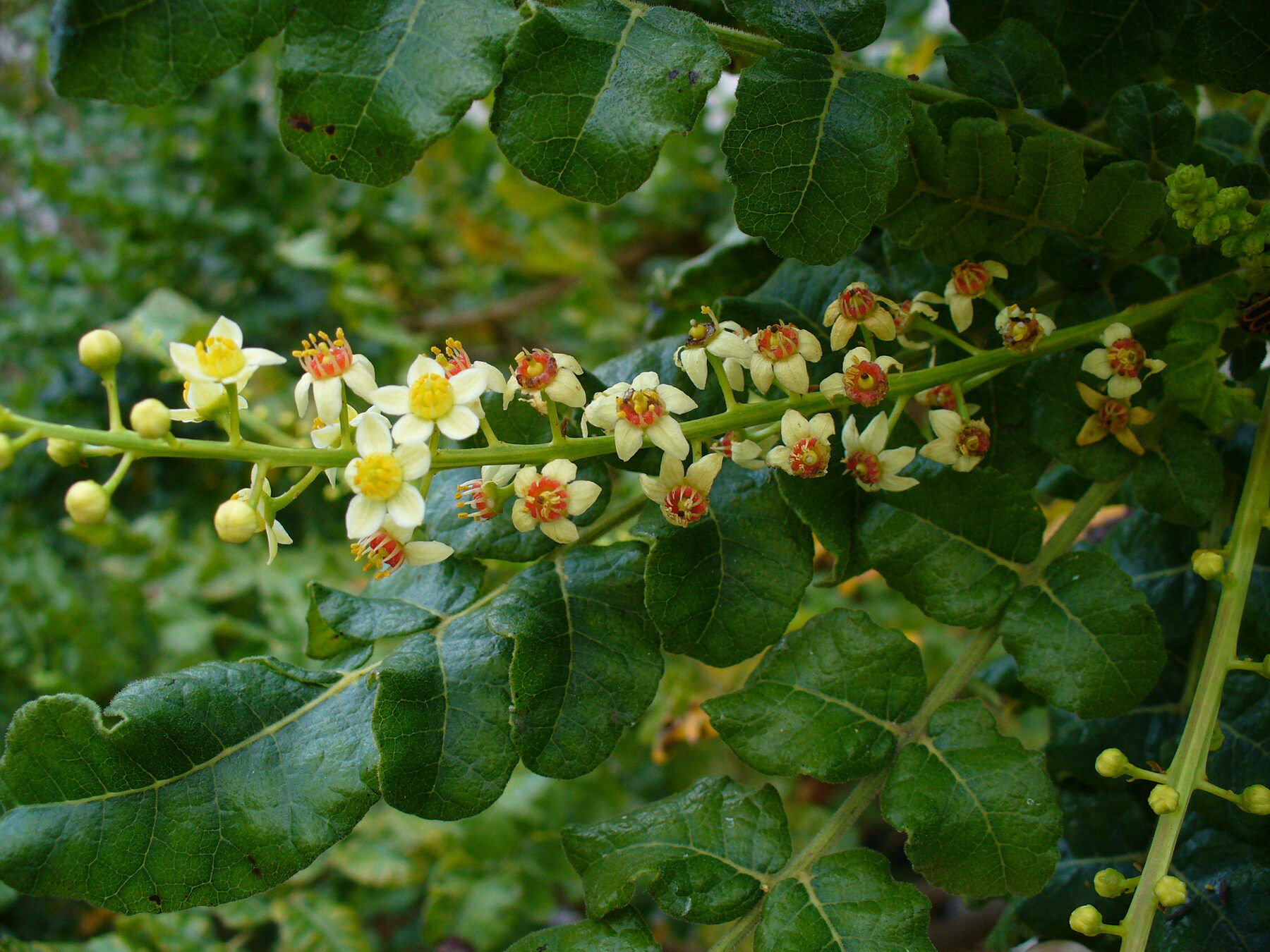
Boswellia sacra stands maybe two to eight metres tall at full maturity. That's not tall. It's a small tree, by any standard. Its bark peels off in papery sheets. Its leaves are compound — a central stem with leaflets arranged opposite each other. In spring, it produces clusters of small yellow-white flowers. From a distance, it looks unremarkable. From up close, you start to see the design.
Where it Grows and Why That Matters
The tree's natural range is narrow. Southern Oman's Dhofar mountains, the Mahrah highlands of eastern Yemen, and parts of northern Somalia. That's it. Within those regions, Boswellia sacra doesn't grow in rich soil. It grows on limestone slopes and rocky ravines, often at elevations up to 1,200 metres, in ground that is mostly broken stone and calcium carbonate. The kind of soil where you wouldn't expect anything green to survive.
But this is exactly what the tree needs. The limestone provides drainage — Boswellia sacra cannot tolerate wet roots. It also provides the alkaline chemistry the tree prefers. Trees growing on limestone produce resin with a measurably different chemical profile than those grown on other substrates. The terpene composition shifts. The alpha-pinene concentration changes. The soil literally shapes the scent.
The monsoon is the second piece. From June to September, the khareef winds sweep off the Arabian Sea and hit the Dhofar escarpment, dumping moisture on the mountains. The rest of the year is dry. Bone dry. The tree has adapted to this extreme seasonality — it goes dormant during the dry months and flushes with growth during the monsoon. The resin it produces is a direct response to this stress cycle. Without the khareef, there would be no tears worth collecting.
The Tree's Biological Design
Look at the base of a mature Boswellia sacra tree and you'll notice something unusual. The roots don't just go down — they flare outward into massive buttress roots that grip the rock. This isn't for nutrient absorption. It's for stability. On a steep limestone slope, a tree that didn't anchor itself properly would slide down the mountain in the first heavy rain.
The trunk stores water internally. The papery bark reflects heat and reduces moisture loss. The compound leaves minimise surface area during dry periods. Every part of the tree's architecture is a response to scarcity. It's not trying to be impressive. It's trying to survive.
And the resin? The resin is the tree's defence system. When the bark is cut, the tree exudes a milky sap that hardens on contact with air, sealing the wound against insects and pathogens. We smell it as perfume. The tree makes it as armour.
The trees don't start producing meaningful amounts of resin until they're about eight to ten years old. A well-managed tree can continue for forty to fifty years. An over-tapped one dies within a decade.
What This Means for the Resin
Our species field guide covers the differences between Boswellia sacra and its relatives — serrata from India, papyrifera from Ethiopia, carterii from Somalia. But the short version is this: the tree that grows in the Dhofar mountains, on limestone, under the khareef monsoon, produces a resin chemically distinct from every other Boswellia species on the planet. It's not better because of marketing. It's better because of biology.
When you burn a tear on an electric warmer, you're experiencing the output of a tree that evolved in one specific place, under one specific set of conditions, over millions of years. The same trees that supplied the Incense Roads are still growing on those same slopes, tapped by the same families, using the same seasonal knowledge.
That continuity is unusual. Most agricultural commodities have been industrialised, homogenised, optimised for yield over quality. Boswellia sacra hasn't. It can't be. The tree won't grow outside its microclimate. You can't farm it the way you farm wheat. You can only visit the places where it already lives, and treat it well enough that it keeps producing.
The Fragile Future
The same specificity that makes Boswellia sacra extraordinary also makes it vulnerable. Its habitat is tiny. Climate change is shifting monsoon patterns. Over-grazing, mining, and unskilled tapping are reducing tree populations. A 2019 study predicted that Boswellia papyrifera populations could decline by 50% within two decades — and sacra faces similar pressures.
We covered the big picture in our piece on frankincense sustainability, but the core point bears repeating: the tree is the bottleneck. Without healthy, mature Boswellia sacra trees, there is no frankincense. Not in any meaningful quality. The resin in your burner starts with a tree that took a decade to reach maturity, on a hillside that took millennia to form, in a climate pattern that took millions of years to stabilise.
Browse our collection of authentic Omani and Yemeni aromatic specimens in The Reserve. Every batch is traceable to specific suppliers who work with harvesters following traditional tapping cycles. The tree matters. We source accordingly.