
How to Tell Real Frankincense from Fake
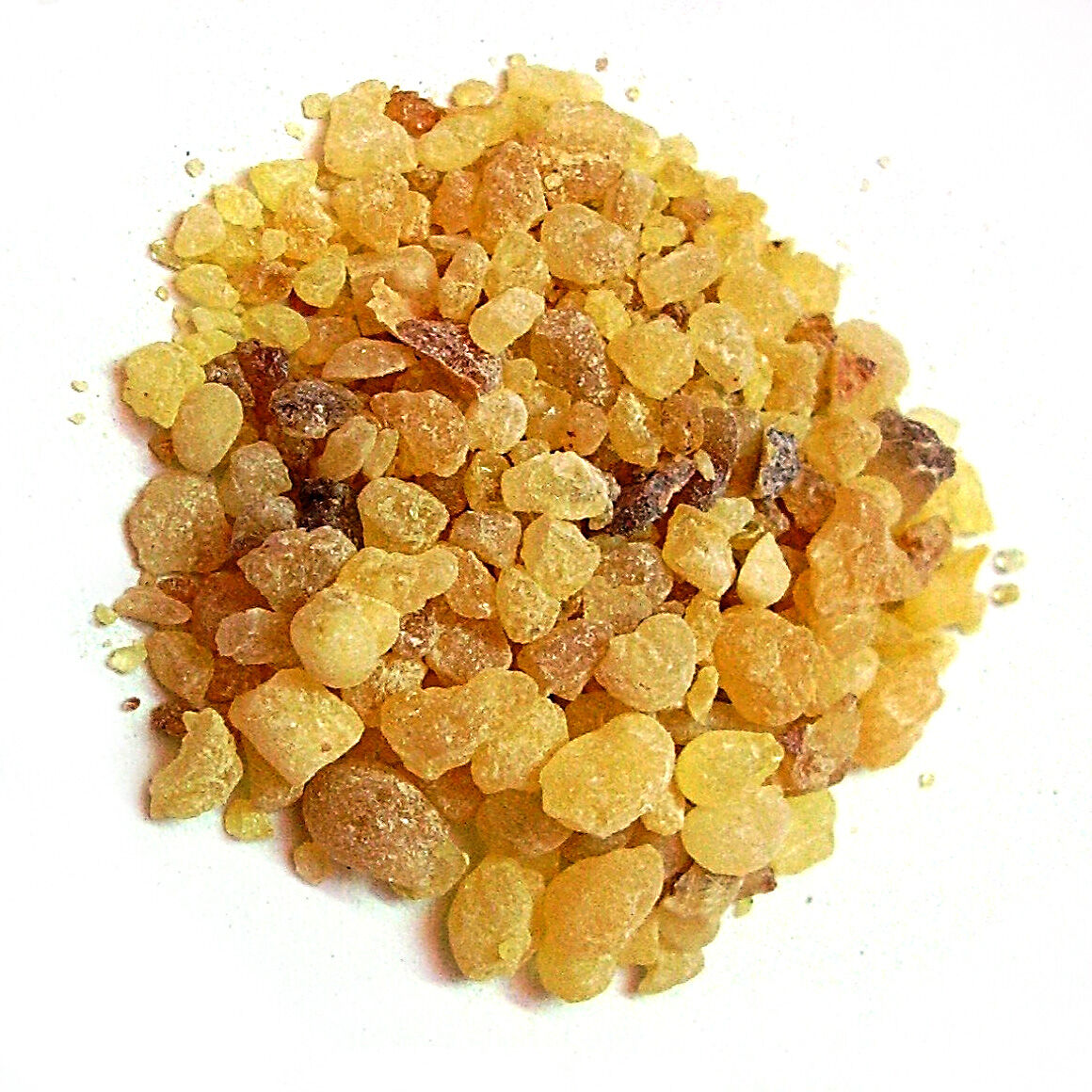
Real frankincense comes from Boswellia trees and smells bright and citrusy when burned. Much of what is sold as frankincense is a different species, stretched with pine resin, or cut with synthetic oils. You can spot most fakes without a lab, and knowing the difference saves your money and your burner.
What Is Real Frankincense, Exactly?
Real frankincense is the hardened sap of trees in the Boswellia genus. When the bark is cut, a milky white sap exudes and hardens into pale amber, greenish, or golden tears. The resin contains a complex mixture of volatile oils (mostly monoterpenes like alpha-pinene and limonene), gums, and boswellic acids. It is harvested by hand, sorted by colour and clarity, and graded accordingly. The top grade is Royal Green Hojari: translucent, emerald-tinted tears with the highest oil content, as we covered in our guide to the sovereign grade.
The gold standard for incense is Boswellia sacra, the species native to Oman's Dhofar region, Yemen and Somalia. But there are at least seven Boswellia species traded commercially, including B. papyrifera from Ethiopia, B. serrata from India, and B. frereana from Somalia. Each has a different chemical profile, and they are not interchangeable on the burner.
What Is Actually Being Sold as Fake Frankincense?
Frankincense adulteration takes several forms. The Botanical Adulterants Prevention Program, a consortium of industry and academic labs, categorises them as follows.
Species substitution. A cheaper Boswellia species is sold as a pricier one. For example, B. serrata (Indian frankincense, used mainly in herbal medicine) is less aromatic than B. sacra. A 2016 study by Niebler and Buettner analysed 46 commercial Boswellia samples and found that several labelled as one species contained the resin of another. Some products labelled B. serrata actually contained B. sacra or B. frereana, which has a completely different chemical profile and lacks the boswellic acids that buyers of B. serrata expect.
Pine resin extension. The same BAPP bulletin reported that two commercial samples of B. serrata contained high levels of longifolene and longipinene, sesquiterpenes characteristic of pine resin. One sample was 34% longifolene by peak area. Pine resin costs a fraction of frankincense and is used to stretch bulk supply.
Synthetic additives in essential oils. A 2022 study by Ojha and colleagues tested 21 commercial frankincense essential oils labelled as pure Boswellia carteri (a synonym for B. sacra). Every single sample was adulterated or contaminated. Six samples contained synthetic limonene, three contained synthetic octyl acetate, three were cut with castor oil, and two contained phthalates. None matched the profile of a lab-distilled control.
Outright substitution. Some products sold as frankincense contain no Boswellia at all. The BAPP report notes that one of 17 top-selling commercial products sampled in the US and Europe contained none of the six characteristic boswellic acids that define genuine Boswellia resin.
How Can You Spot Fake Frankincense at Home?
Four quick checks will catch the most common fakes. None of them are foolproof against sophisticated adulteration, but they will filter out the bulk of the low end.
Visual check
Real frankincense is a gum resin. It fractures conchoidally, like glass, with sharp edges and a waxy sheen. Good-grade tears are translucent, ranging from pale yellow through greenish-amber. If the resin looks matte, crumbly, or dusty, it is either low grade, old, or mixed with debris. Pine resin looks similar at a glance but fractures differently: it is glossier and more brittle, with a different fracture pattern.
Float test
Real frankincense floats in water. Its density is around 1.0 to 1.1 g/cm3, just above water. Most filler resins and synthetic substitutes are denser and sink faster. Drop a tear in a glass of room-temperature water: if it sinks immediately, that is a red flag.
Burn test
This is the most reliable home test. Place a small piece on an electric burner at 180 degrees. Real frankincense melts into a clear or pale amber liquid, then releases a bright, citrusy, pine-like scent. It should not smoke heavily, bubble excessively, or smell like a chemical diffuser. If it produces black soot, an acrid chemical smell, or smells like a Christmas candle, you have a fake.
Scent alone
Real B. sacra frankincense has a specific scent profile: lime zest, pine needles, a hint of eucalyptus, and a warm balsamic base. It is distinct from myrrh (earthy and bitter), copal (sweeter and more vanilla-like), and pine resin (sharp turpentine notes). If you have smelled real high-grade hojari once, your nose knows the difference. As the field guide to frankincense species explains, different Boswellia species have distinct chemical profiles and smell notably different.
Why Does It Matter Which Boswellia Species You Buy?
Because each species burns differently. B. sacra produces the bright, piercing, citrus-forward scent that most people associate with frankincense. B. papyrifera produces a softer, woodier smoke with notes of incense acetate. B. serrata contains methyl chavicol and methyl eugenol, giving it a sweet, anise-like note that is pleasant but not what a buyer expecting B. sacra wants. And B. frereana contains no boswellic acids at all, so its chemical profile is completely different.
The CITES working document on Boswellia identification published ahead of CoP19 notes that these differences are detectable by standard analytical methods including gas chromatography and high-pressure liquid chromatography, but also by sensory analysis: the scent and appearance of the resin are often enough to differentiate the majority of samples.
What Do the Lab Tests Show?
The research paints a clear picture. A 2018 review from the Botanical Adulterants Prevention Program found that 18 to 43 per cent of commercial Boswellia products they tested showed signs of adulteration, ranging from species substitution to pine resin extension. A 2022 study by Ojha at the University of the South Pacific in Fiji tested 21 commercial frankincense essential oils; all 21 were adulterated or contaminated. The most sophisticated detection method is chiral gas chromatography, which measures the ratio of left- and right-handed molecules of key terpenes. When synthetic limonene is added, the natural enantiomeric ratio shifts in a way that cannot be hidden.
This is not a niche problem. The global frankincense market has grown significantly, and supply chain transparency has not kept up. A 2024 review published by MDPI notes that authentication is complicated by overlapping chemical profiles between species, variation from growing conditions, and the lack of certified reference materials. The same review recommends orthogonal testing: using multiple complementary analytical methods rather than relying on a single test.
How to Buy with Confidence
Buy from a source that names the Boswellia species and the country of origin. Resin labelled simply as "frankincense" with no species or region is a red flag. Look for suppliers who can tell you the harvest season, the village or region, and the grade. The resin trade historically ran on trust and relationships, and that model still works: a supplier who can name the harvester is a supplier who knows their supply chain.
Start with a small sample and burn it before buying bulk. The home tests above (visual, float, burn, scent) will catch the most common fakes. Once you know what Royal Green Hojari smells like, you will not be fooled by a lower species or a pine-resin blend. Our Reserve names the species, the region, and the grade for every product, because that is the minimum a buyer should expect.
- Comparison of Volatile Constituents Present in Commercial and Lab-Distilled Frankincense Essential Oils for Authentication - Plants (2022)
- Boswellia serrata Botanical Adulterants Bulletin - ABC-AHP-NCNPR Botanical Adulterants Prevention Program (2018)
- Identification of Boswellia Trees, Resins and Essential Oils - RBGE / CITES (2024)
- Organic Certification is Not Enough: The Case of the Methoxydecane Frankincense - PMC (2019)